

6 quality defects found in shoes andQuality control methods

Shoes are part of our daily necessities. We need them for outdoor activities. Besides the design of the shoes, the quality of production is also a factor that determines the success or failure of the shoes. Defects in shoes can bring us discomfort and even health problems. End users must know about these shoe defects in order to choose quality shoes. Shoe manufacturers should also know how to improve the quality of shoes to increase customer satisfaction.
In this article, you will find a categorization of defects that explains the various stages of shoe defects. In addition, we will explain the defects you find in shoes and their solutions. With this information, you can detect shoe defects and avoid them to find shoes that satisfy you. Let's get started!
How do experts categorize quality defects in footwear quality control?
The quality control process is crucial in categorizing poor quality shoes based on several levels. Let's see how experts categorize defects.
1. Critical defects
Critical defects are the most dangerous defects. These shoe defects don't even meet the basic regulations for shoes. In fact, critical defects can pose a risk to your health and safety.footwear manufacturerShoes should be rejected for these products that are considered nonconforming.
2. Major deficiencies
Major defects are shoe defects that affect appearance, durability and marketability. Due to the presence of major defects, your customers will not be satisfied with the shoes. As a result, you may have a poor reputation, low customer satisfaction, and declining sales.
3. Minor defects
Minor defects are small quality flaws that cause a shoe to have a slight defect. Overall, the shoe is still wearable. Usually, it will still satisfy you. However, this can lead to differences in customer expectations of quality standards.
Zones 1 and 2 are used for defect classification
In shoe quality control, it's important to know where zones 1 and 2 are in a shoe:
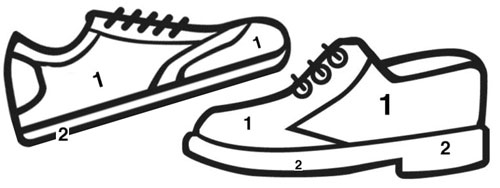
Footwear-Zone-1 and Zone-2-Failed Classification Zone 1
Zone-1
It is the most important part of the shoe. This is most noticeable on the front and sides of the shoe. For example, the toe portion of the shoe. Therefore, any quality defects found in this area are major defects as they affect the appearance of the shoe.
Zone-2
Area 2 is less important than Area 1. You will probably not notice this area as often as you would in Area 1. Examples of zone 2 are the heel and sole portions of the shoe. If you find defects in the shoe in zone 2 of the shoe, they are likely to be minor defects.
6 common defects in footwear production
After we have categorized the defects, let's see what kind of quality defects can be found in the quality control of the shoes produced.
Problem 1: Too much wax, oil or glue
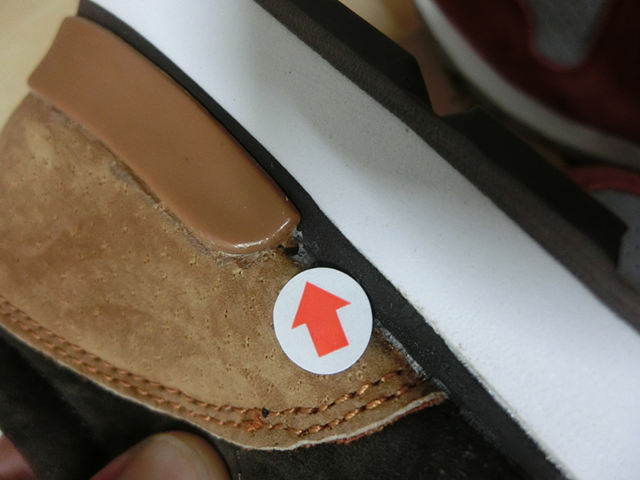
Shoe Defects and How to Perform Quality Control on Shoes During the shoe making process, various parts of the shoe are bonded with chemicals such as glues, waxes and oils. When workers use too much of these chemicals, they leave a residue on the shoes. This residue can affect the appearance of the shoe and leave you dissatisfied.
This quality defect is the most common major defect in shoes in zones 1 and 2. Usually, you can easily clean these adhesives. However, if you don't notice and clean it before packaging, customers will be dissatisfied with its appearance.
Solutions to avoid too much wax, oil or glue
There are many solutions to this quality defect problem. First, providing training to factory workers is the simplest solution. If they are properly trained, they will be able to use the correct amount of chemicals on the shoes. This will avoid excessive waxes, oils and glues.
In addition, closely monitoring the production line is a great solution. You can quickly spot any workers who are not using the correct chemicals. This will help avoid the problem before customers receive their shoes.
Another way to address this shoe defect is to perform a quality check. It ensures that every pair of shoes produced is free of excess wax, oil or glue. Even if they find it in the shoe, it is promptly wiped off before packaging.
Problem 2: Flaking material
You can find defects in leather shoes of this kind. This is a major defect as you can easily see the flaking on the surface of the shoe.
This problem occurs because the leather or material used is of low quality or the material is old. This means that any scratches can easily peel off the surface of the shoe. Poor maintenance of equipment in production can also lead to this problem in shoes.
The solution to avoid material flaking:
In order to address this shoe defect, manufacturers can perform quality checks when selecting materials. This way, the manufacturer can ensure that the materials used are not of low quality or old. These shoes are made from high quality materials that do not flake easily.
In addition, it is vital to remind workers to be gentle when handling shoes. It helps prevent careless behavior and human error in the production of shoes.
In addition, footwear manufacturers should maintain the equipment they use. You can avoid scratching your shoes due to the age of the machines.
Problem 3: Weak bonding/seam breakage
Sometimes glue or stitching is needed to bond shoe materials together. However, the glue used on shoes can be weak. This can cause the material to peel off and lead to serious defects in the shoe.
Stitches can also come off in some shoes. The stitches are not sewn tightly or the thread used is weak.
Solutions to avoid weak adhesion/seam breakage.
There are many ways to avoid weak adhesives and broken pins. First, the manufacturer can ensure that the right adhesive is used. This will ensure that the materials are bonded together tightly and stably.
They must also make sure that the workers use enough adhesive. This way, the adhesive can manage to bond the entire area without leaving any place behind.
Manufacturers can use stronger threads for stitching to keep the material tightly together. You will be able to avoid loose threads and material tears to prevent quality defects.
Problem 4: Inaccurate dimensions
All shoes should be made to universal sizing standards. Customers expect the shoes they choose to fit their feet accurately.
But sometimes, the shoes may be mislabeled or packaged in the wrong size. Such shoe defects are considered serious as the customers cannot even wear the shoes they bought.
Solutions to avoid dimensional inaccuracies.
You can avoid shoe size problems in a number of ways. The manufacturer should install the machine in the right place. This way, the shoes can be properly labeled in the right place.
Additionally, footwear manufacturers can use packing lines to pack shoes correctly. It ensures that workers know which size to pack on which box.
Ensuring a well-organized factory also helps the production line run smoothly and error-free. Workers can concentrate more on their work in a clean and tidy environment to minimize errors.
Problem 5: Sharp metal contamination
Some shoes need nails or metalwork to bind them. If the nails are not pressed properly, they can pull out. Then, it can hurt your feet when they pierce your skin.
This shoe defect is dangerous because it can cause physical harm to the end customer. Therefore, it is categorized as a critical defect.
Solutions to avoid sharp metal contamination.
You can easily avoid sharp metal contamination using a number of solutions. The easiest way is to use a metal detector to detect unwanted metal objects in your shoes. Workers can then remove them to ensure the safety of the wearer.
Alternatively, a manufacturer can set up a footwear quality control department. It can make sure that the shoes are manufactured correctly. For example, making sure that nails are pressed down correctly or that there is no metal in the shoe.
Frequent checking of your quality control process is also a way to avoid this problem. It will further enhance your quality control process to improve your brand standards.
Issue 6: Wear marks
Wear marks are marks on a clearly visible area 1 on a shoe. These marks are usually found on leather or shiny shoes.
This can happen if the workers are careless or rude and leave these marks on the surface of the shoes. Apart from that, machines may also cause these marks during the production process.
Solutions to avoid wear marks.
Shoe manufacturers can address wear marks in different ways. One of these is to investigate the factors and stages of production that lead to these wear marks. The manufacturer can then correct the problem at each stage and handle the shoes better.
In addition, manufacturers can hire third-party quality inspectors at their factories. They can check the quality of the shoes before they reach the customer.
In addition to this, workers must wear appropriate clothing. For instance, workers should avoid using rings that may cause signs of wear and tear. They should also wear gloves to ensure that the surface of the shoes is perfect so as to avoid defects in the shoes.
Conclusion.
Many quality defects can be found in shoes. These defects can be categorized into three stages and 2 areas on the shoe. Fortunately, there are many solutions available to fix these shoe defects accordingly. By ensuring that the shoes are checked for quality, you can provide better quality to your customers. This will increase your brand reputation, customer satisfaction and company sales.
I hope this article has provided you with information about theShoe quality defectsand important information about its solutions. Please feel free to contact us for any questions regarding quality control of shoes.

 Chinese
  English
  Japanese
  Korean
  Indonesian
  German